
The 5 hidden costs of poor internal communication




The 5 hidden costs of poor internal communication
TLDR: The hidden costs of poor internal communication never land on the comms budget. They land somewhere else – as work done twice, as a safety incident, as someone handing in their notice. Costs without a name don’t get owned, so the wrong problem gets fixed.
Every large organisation has a communications budget. Almost none of them know what communication costs.
Those are two different questions. The budget tells you what you spent on communicating. It tells you nothing about what you spent because people didn’t know.
The second number is bigger. It also doesn’t have a name, and that turns out to be the whole problem.
Finance can count anything with a label. A line called “internal communications” gets reviewed every year, defended, sometimes cut. A cost with no label just gets absorbed. It turns up as a project that ran long, a shift staffed wrong, a resignation filed under “personal reasons”. All real numbers. None of them filed under communication.
What are the hidden costs of poor internal communication?
The hidden costs of poor internal communication are what an organisation spends when people act on information that was late, unclear, or wrong. It isn’t the cost of writing a bad message. It’s the cost of what happens next.
That difference matters. A badly written email costs the twenty minutes it took to write. The rework, the phone calls, the meeting booked to work out what it meant, the three people who did the wrong thing for a fortnight – that’s the cost. And it arrives later, somewhere else, under a different name.
Which is why nobody can see it. It isn’t hidden. It’s spread out.
The five hidden costs
Follow the money and it doesn’t lead back to the comms team. It leads to five other places.
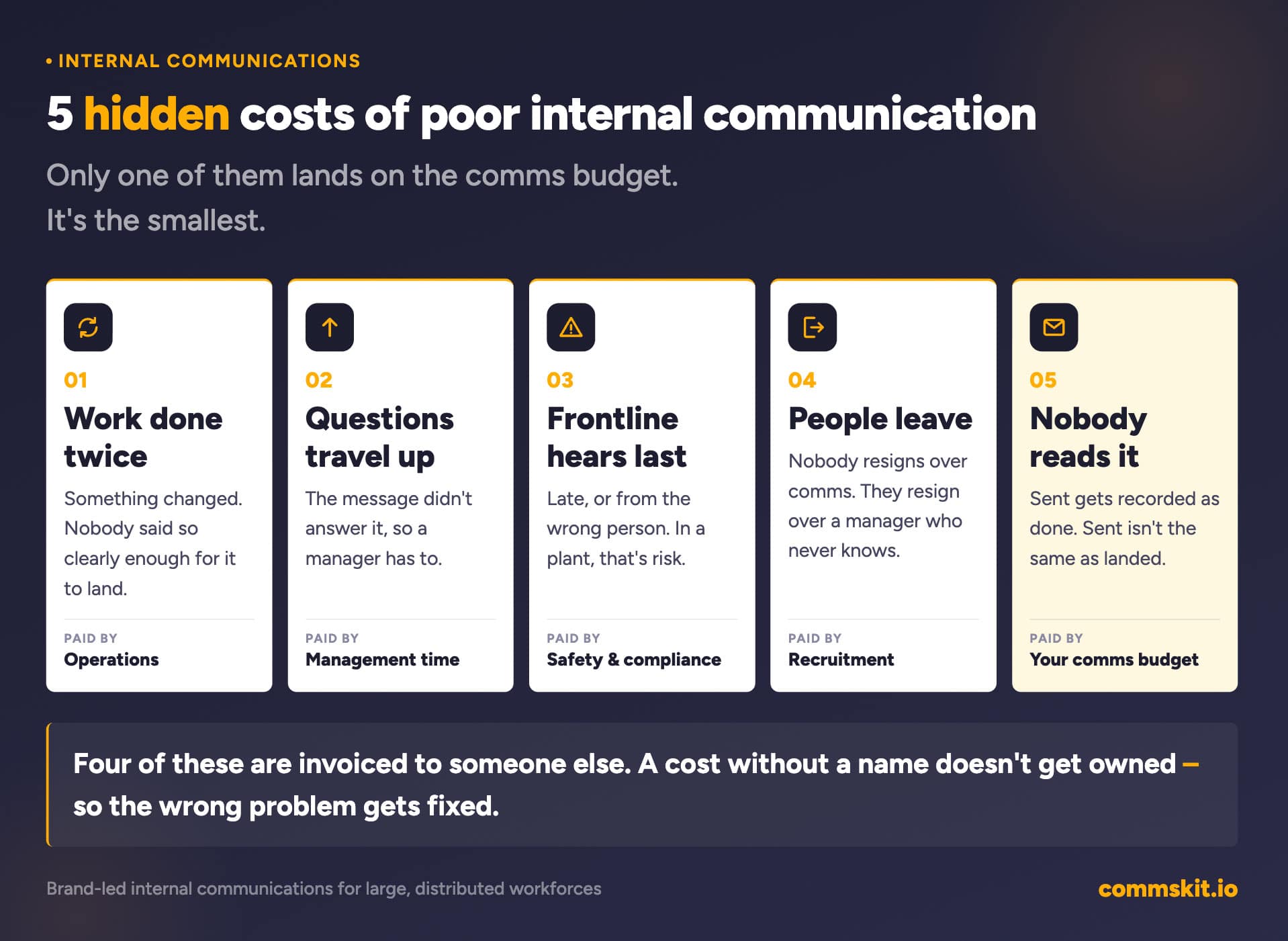
1. Work done twice – paid by operations
The message went out. Then it went out again, because something had changed and nobody said so clearly enough for it to land.
In between, work happened. Now some of it has to be undone. The plan built to the old spec. The order placed against the old requirement. None of this gets recorded as a communication problem. It gets recorded as rework – which has its own budget, its own owner, and its own explanation. The explanation usually involves the word “scope”.
Operations pays. Operations doesn’t know what it’s paying for.
2. Questions travelling upwards – paid in management time
When a message doesn’t answer the question, the question doesn’t go away. It goes up.
The supervisor asks the manager. The manager asks their boss. Each of those conversations burns expensive time doing a job the message should have done once, for everyone, for free.
This is the most invisible cost of the five, because it looks exactly like managers managing. Nobody logs it. It just eats the day.
It also lands on the worst possible person. Gallup’s State of the Global Workplace research attributes 70% of team engagement to the manager. So this isn’t only a time cost. You’re charging it to the one person who decides whether the team is engaged at all.
3. The frontline hears last – paid by safety and compliance
Deskless workers find out late, or from the wrong person, or in a version that changed on the way down.
In an office, that causes confusion. In a plant, a depot or a ward, it causes risk. A procedure that changed on Monday and reached the night shift on Thursday isn’t an inconvenience for three days. It’s three days of people doing something the organisation has already decided is unsafe.
When that goes wrong, it’s logged as an incident. It gets investigated as an incident. The fix addresses the procedure. Almost never does anyone conclude that the procedure was fine and the delivery was broken – because there’s no box on the form for that.
4. People leaving managers who can’t answer questions – paid by recruitment
Almost nobody resigns over communication. Plenty of people resign over a manager who never seems to know what’s going on.
Those are the same thing, seen from different distances. The manager isn’t holding back. They usually haven’t been told either. But the employee can’t see the three levels above where it broke. They just see someone who doesn’t know, and they draw a fair conclusion about how much this place cares whether they know.
Then they leave. Recruitment pays to replace them. That cost is measured precisely – and blamed on the wrong thing.
5. Messages nobody reads – paid by the comms budget
Here’s the twist. The only communication cost with a name on it is the one you can already see. And it’s the smallest.
Your comms budget is real, tracked, and defended every year. It’s also, in most large organisations, part-spent on messages nobody opened or acted on. That spend gets recorded as delivered. Sent equals done.
So the one line everyone can see is measuring the wrong thing, while four lines nobody’s looking at pick up the bill. That’s not a mistake. It’s how the accounts were set up.
Measuring whether a message arrived, rather than whether it was sent, runs through most of the internal comms trends worth bothering with.
Why the wrong problem keeps getting fixed
Here’s the mechanism, and it’s simpler than it looks.
A cost without a name can’t be owned. A cost nobody owns can’t be diagnosed. And a cost nobody can diagnose gets blamed on whatever’s closest – which is always the symptom.
So operations buys a better project management process. Safety runs another toolbox talk. HR launches a retention drive. Four teams, four budgets, four fixes, all aimed at four symptoms of one thing. Each one is sensible on its own. Together they treat a delivery problem like four separate performance problems.
Meanwhile the comms budget – the one place that could address the actual cause – gets picked over in isolation. Which is odd, because it’s the only function asked to prove its worth using someone else’s ledger.
And when someone does finally suspect comms is involved, the instinct is to make it louder rather than make it land. That’s the point where the difference between internal communications and internal marketing stops being a semantic argument and starts costing money.
None of this is anyone’s fault. The categories were set up before anyone asked what confusion costs, and nobody’s been back to look since.
Is it a communication failure or a design problem?
There’s a quick test.
If a message fails and a better message fixes it, that was a communication failure. If a message fails, you write a better one, and it fails again six weeks later – you haven’t fixed anything.
Signs it’s structural rather than a matter of effort:
- The same message has to go out three times before it lands. Every time. Whoever writes it.
- Managers are acting as unpaid translators, turning head office messages into something their team can use.
- The frontline hears big news from a colleague before they hear it from you.
- Two departments describe the same change in different words in the same week.
- Nobody can tell you where a message went after it was sent.
Every one of those survives a change of staff. That’s what makes it design, not effort. If better writing were the fix, better writers would have fixed it by now. Large organisations employ good communicators and the same things still go wrong – which tells you writing was never the constraint.
A systemised approach to internal health and safety campaigns works for the same reason. It treats reach and repetition as structural questions, not effort questions.
How to find the cost in your own organisation
Stop trying to price communication. Go and ask the four budget holders what it’s costing them.
Operations: how many hours went on redoing work that was right when it started? Don’t ask why. Ask how much.
Managers: how much of your week goes on answering questions your team should have been able to answer from something we sent them? Ask five people. The number will be consistent and it will be uncomfortable.
Safety: in your last twelve investigations, how many involved someone acting on information that was out of date or hadn’t reached them? Don’t ask “was communication a factor” – nobody says yes to that. Ask what they knew and when.
HR: how often does some version of “I never knew what was going on” come up in exit interviews? It won’t be filed under communication. Look anyway.
Then do one more thing. Split your own budget into what you spent sending and what you can prove arrived. If you can’t tell the difference, that’s your first finding – and it’s the one that makes the other four credible.
Now you’ve got four numbers from four teams, none of them yours, all describing the same failure. That’s not a communications case. It’s an operational case with a communications answer. It’s also the only version of this argument a finance director has ever found convincing.
You’re not trying to reach a total. You’re trying to give the cost a name, so somebody can own it.
Because it was never hidden. It was just filed under someone else’s problem – and once it has a name, it stops being everyone’s problem and becomes somebody’s job.
If you’re at the point of naming it and want the structure to fix it, commskit.io is a good place to start.
Managing internal communications for large workforces is hard.
CommsKit™ makes it easier.
Disconnected people makes workplaces less safe and businesses less productive.
CommsKit has a managed solution that solves this challenge – consistently and on brand.

Discover ENGAGE →
A managed monthly communications programme – brand-aligned campaigns created, designed, and delivered on a fixed calendar. Your team approves. We do the rest.

CONNECT
Managed digital employee communications hub


ONBOARD
A consistent, repeatable onboarding system