
Sustainability communications: reaching the workforce that delivers the targets



TLDR: Most sustainability communications are built for investors, regulators and customers, then forwarded to employees as an afterthought. The people who actually move the numbers – the ones on shift, on plant, on the road – rarely get a version written for them. Internal sustainability communications work when the target is translated into the task, delivered in the channel the working day allows, and repeated long enough to become habit.
The annual sustainability report is often the best-produced document an organisation makes. Photography commissioned. Data assured. Targets set against a baseline year and signed off by the board.
Then it goes out. To investors, to regulators, to customers, to the ratings agencies. And a link to the PDF goes to everyone else.
That link is where most sustainability communications quietly stop. It reaches the people with a company laptop and an inbox they check. It does not reach the shift supervisor, the driver, the ward, the warehouse or the pit. Those are the people whose daily decisions move the numbers the report is reporting on.
This is rarely a failure of effort. The external programme tends to be excellent because it has a deadline, a named audience and a budget attached to a regulatory date. The internal equivalent usually has none of those things, because it was never commissioned as a programme in the first place.
Research from the University of Pittsburgh’s Center for Sustainable Business, published in MIT Sloan Management Review, puts a number on the gap. Of 1,056 US employees surveyed, only 30% strongly agreed that they understood how to improve their company’s sustainability performance through their own role. Forty-five per cent said they did not know what actions to take.
The strategy is not the problem. The translation is.
What are internal sustainability communications?
Internal sustainability communications are the planned messages, formats and listening routes that connect an organisation’s environmental and social targets to the daily work of its own employees.
External sustainability communications answer the question what has this organisation committed to? Internal sustainability communications answer a different one: what does that commitment mean for the job I am doing on Tuesday?
The two are related but they are not the same asset resized. An investor wants scope 3 emissions against a 2019 baseline. A maintenance technician wants to know which of the four things they do before shift end now matters more than it did last year, and why. Sending the first to the second is not communication. It is distribution.
Why sustainability communications stop at the office door
The same MIT Sloan research found a measurable split by role. Managers in corporate positions were on average around 15% more likely than frontline non-managers to see sustainability as embedded in the business. The people furthest from head office were the least likely to recognise the strategy as anything to do with them.
Deloitte’s ConsumerSignals survey found something similar from the other direction: 45% of employees had never discussed sustainable practices at work with their manager or supervisor. Not disagreed with them. Never discussed them at all.
Three structural reasons account for most of this.
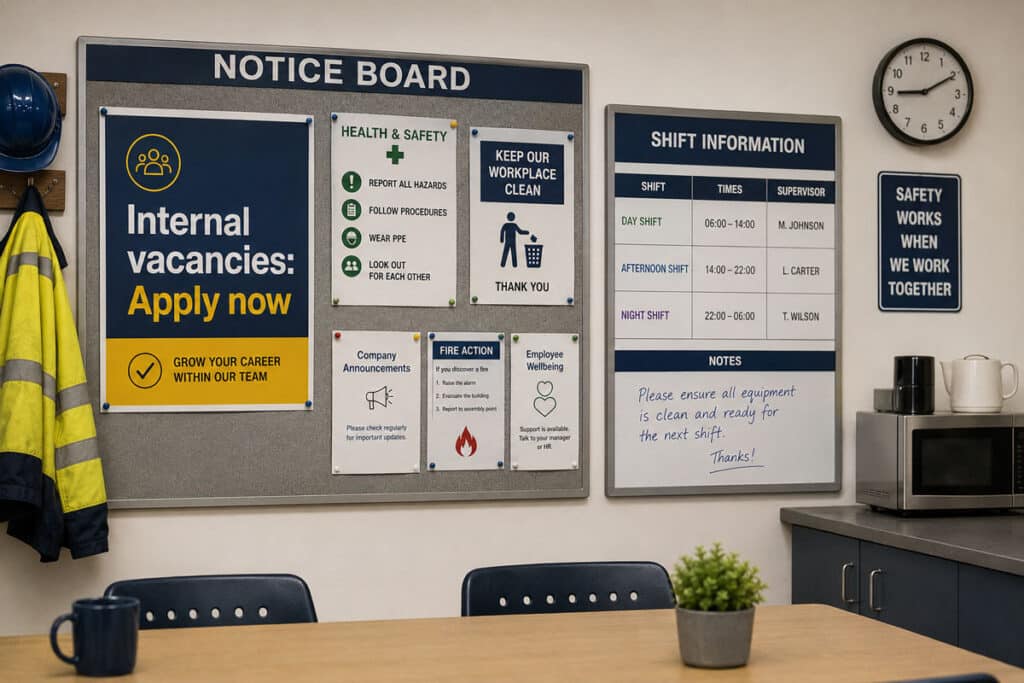
The channel does not fit the job. Sustainability communications are usually built as email, intranet posts and long PDFs. A workforce without desks does not consume any of those formats reliably, and often cannot access them at all.
The message is written for a different reader. Assurance language, baseline years and scope definitions are precise for the audiences that require precision. They carry almost no meaning for someone deciding whether to idle a vehicle.
Nobody owns the internal half. Sustainability sits with the ESG or HSE team. Internal comms sits elsewhere and is usually running four other programmes. The report gets a project plan. The workforce version gets a forward button.
Five things internal sustainability communications have to do
1. Show the commitment where people work, not only where investors read
Employees form a view of whether the organisation means it long before they read anything. They form it from what they see on site: whether the recycling stream is actually separated at the end of the shift, whether the leak reported in March has been fixed, whether the new equipment arrived.
Sustainability communications that arrive in an inbox while the visible evidence says otherwise do not build trust. They cost it. The first job of an internal programme is to make the real, visible, local proof legible – then connect it upwards to the corporate target, rather than the other way round.
2. Translate the target into the task
“Net zero by 2040” is a commitment. It is not an instruction. Somewhere between the board target and the individual role there needs to be a translation layer, and in most organisations that layer does not exist.
The translation is site-specific and role-specific. For a logistics operation it might be route planning and idling. For a hospital it might be theatre waste segregation and anaesthetic gas capture. For a processing plant it might be water reuse and compressed air leaks. The corporate target is one message. The translated versions might number thirty.
This is the part that gets skipped, because it is the part that takes work. It is also the part that determines whether anything changes.
3. Give people a reason to stay, not just a reason to applaud
Sustainability is now a factor in where people choose to work and whether they remain. Deloitte’s ConsumerSignals data found that 27% of respondents would consider a potential employer’s position on sustainability before accepting a job, and about a quarter had considered switching jobs to work for a more sustainable company.
That matters most in sectors that already struggle to recruit. If your organisation has a credible environmental record and the workforce does not know the detail, you are carrying the cost of the programme without the employer brand benefit. Internal sustainability communications are where that record becomes something an employee can repeat to a friend.
4. Treat employees as a stakeholder group with a return channel
Most sustainability engagement plans list employees as a stakeholder and then design a one-way flow to them. Community engagement gets forums, panels and structured feedback. Employees get a newsletter.
A return channel changes what the programme knows. It surfaces the practical objection – that the new procedure adds eleven minutes to a changeover, that the bins are in the wrong place, that nobody told the night shift. Those objections are the difference between a policy that exists and a policy that operates. The same principle applies to ESG and community engagement in mining, where the listening structure is often better built for external communities than for the workforce.
5. Collect the ideas that only exist at the coalface
The person who knows which compressor has been leaking for two years is not in the sustainability team. Efficiency knowledge sits with the people who work with the equipment daily, and it stays there unless something is built to collect it.
The MIT Sloan research found that only 31% of employees strongly agreed that their company celebrates sustainability successes, and 48% cited the absence of a sustainability culture as a major or moderate impediment. Recognition is not decoration here. It is the mechanism that tells the next person their suggestion will be taken seriously.
What this looks like across mixed-access sectors
The structural problem is consistent across industries. The specifics are not.
Manufacturing and processing. Energy and water use are measured continuously and understood locally. Shift-level data displayed at the line, in language the line uses, tends to outperform any corporate campaign.
Transport and logistics. Fuel, route and idling behaviour sit with individual drivers who are rarely in a building. In-cab and mobile-first formats are not a nice-to-have; they are the only channel that works.
Healthcare. Waste segregation, procurement and clinical gases carry significant environmental weight, and the people making those decisions are working to clinical priorities first. Sustainability messages have to attach to existing clinical routine rather than compete with it.
Mining and energy. Rehabilitation, water stewardship and community impact are already highly documented for regulators. The internal version is usually the weakest link in an otherwise rigorous chain.
Utilities and public sector. Large, geographically spread workforces with long tenure and strong local identity. Site-level pride is a more effective lever than a national message.
Across all of these, the constraint is the same: a multilingual and mixed-access workforce cannot be reached by one format in one language sent to one address.
How to build a sustainability communications programme
A practical sequence for the internal half.
- Audit reach before content. For each site and role, establish what can actually be received: personal device, shared terminal, notice board, toolbox talk, supervisor briefing. Reach determines format. Format determines message length.
- Pick three targets, not seventeen. Choose the commitments where employee behaviour materially affects the outcome. The rest can be reported rather than communicated.
- Write the translation layer. For each of the three, produce a role-level statement of what changes and what stays the same. Test it with a supervisor before it goes anywhere.
- Build the supervisor version first. Line managers and supervisors are the channel with the highest trust and the least support. Give them a briefing they can deliver in five minutes without preparation.
- Open one return route and answer it visibly. A single question channel that is actually read beats three that are not. Publish what changed as a result.
- Set a repeating rhythm. Sustainability is a multi-year programme communicated as an annual event. A monthly cadence with a small amount of content outperforms an annual launch with a lot of it. This is the same logic behind integrated internal communications campaigns – planned, repeatable, cumulative.
- Measure understanding, not distribution. Open rates tell you the message left. A short quarterly pulse asking whether people can name one thing their role contributes tells you whether it arrived.
Common questions
Where this usually lands
The organisations doing this well are rarely the ones with the largest communications team. They are the ones treating sustainability communications as a designed, running programme rather than an annual asset – reach mapped, message translated, supervisors equipped, rhythm maintained.
That is deliberate, ongoing work, and it sits awkwardly between a software platform that will distribute whatever you give it and an agency that will produce a campaign and leave. CommsKit exists in that gap as a managed service, running the programme month to month for organisations whose workforce is mostly not at a desk. If the internal half of your sustainability communications has never been designed as a programme, commskit.io is a good place to start.
Managing internal communications for large workforces is hard.
CommsKit™ makes it easier.
Disconnected people makes workplaces less safe and businesses less productive.
CommsKit has a managed solution that solves this challenge – consistently and on brand.

Discover ENGAGE →
A managed monthly communications programme – brand-aligned campaigns created, designed, and delivered on a fixed calendar. Your team approves. We do the rest.

CONNECT
Managed digital employee communications hub


ONBOARD
A consistent, repeatable onboarding system