
ESG community engagement in mining starts with the workforce


TLDR: ESG community engagement in mining usually fails on visibility rather than investment – the schools, clinics and enterprise programmes are real, but almost nobody nearby can name who funded them. The fastest route to visibility is the workforce, because at most operations the people who live in the community are the people on site. Awareness is not a communications afterthought – it is part of the social licence itself.
A mine can spend hundreds of millions on community development and still be told, at a community meeting, that it does nothing for the area.
That gap is not a failure of intent. The programmes exist. The spend is audited, reported to the board and disclosed in the sustainability report. What is missing is any mechanism that connects the investment to the people it was meant to serve, in a form they can recognise and repeat. A clinic with no sign on it is just a clinic. A bursary scheme nobody can name is a rumour. A supplier development centre becomes, in the local telling, something the government built.
External affairs teams know this. They are usually the ones raising it. The difficulty is that ESG community engagement in mining is split across functions – social performance runs the projects, communications runs the channels, and neither owns the join. So awareness gets treated as an output at the end of a project rather than a designed part of it, and it slips.
This article looks at why ESG community engagement in mining so often stalls at the awareness stage, why the workforce is the most underused route to fixing it, and what a repeatable approach looks like in practice.
Why does ESG community engagement in mining fail on awareness, not investment?
ESG community engagement in mining is the ongoing relationship between an operation and the people who live around it – covering consultation, community development spend, grievance handling and the day-to-day conduct that shapes local trust. Most operations invest seriously in the first three. Very few design the fourth as a communications system.
Three structural reasons account for most of the gap.
Reporting flows upwards, not outwards. ESG reporting is built for investors, regulators and ratings agencies. The formats that satisfy those audiences – annual reports, disclosure frameworks, indices – are not read by anyone within fifty kilometres of the pit. The organisation ends up with a large evidence base pointed entirely in the wrong direction.
The projects are handed over and then let go. A build completes, the ribbon is cut, and the file closes. There is rarely a plan for what the community should still understand about that project in year three, or how a new arrival in the area would ever learn who paid for it.
Nobody is accountable for local recall. Teams measure spend, beneficiaries and completion. Almost nobody measures whether the community can accurately attribute the work. What is not measured does not get managed, and awareness quietly falls off the end of every project plan.
The commercial consequence is not abstract. Research from the Centre for Social Responsibility in Mining at the University of Queensland and the Harvard Kennedy School found that a major mining project with capital expenditure of US$3–5 billion can lose roughly US$20 million a week in net present value terms when community conflict delays production. EY’s 2026 risk survey of 500 senior mining executives placed licence to operate fifth in its top ten business risks for the year, noting that communities increasingly expect operations to fill gaps left by reduced government spending.
Set those two findings beside each other and the picture is uncomfortable. The expectation on mines is rising. The mechanism for showing what has already been delivered is, in most cases, nothing more than word of mouth.
What happens when a community cannot see the investment
One operation we worked with was, by any measure, deeply committed to the area around it. Working with local leaders, it had funded schools, medical clinics, sporting facilities and cultural programmes. It had built out business development centres and commercial education for local enterprises. It employed roughly three in four working people in the surrounding community. It was the economic foundation of the district.
It was also dealing with sabotage, violent incidents and eventually a shutdown.
The brand and perception audit found something that had not appeared in any operational review. Across almost every one of those funded projects, there was no branding, no attribution and no explanation of who had paid for what. Hundreds of millions of dollars of investment, and no visible link back to the company that made it. Community members had concluded, reasonably, that the mine took from the area and gave nothing back. They were not being obstructive. They were working from the only information available to them.
The company was not failing on ESG. It was failing on evidence. And because nothing marked the difference between what the mine funded and what simply appeared, resentment built against an organisation that was in fact the community’s largest single benefactor.
That is the cost of treating awareness as optional. It is worth saying plainly: the teams involved were doing careful, serious work. Nobody had been asked to design the visibility layer, so nobody built it.
Why the workforce is the fastest route to community awareness
Here is the part most ESG community engagement in mining strategies skip.
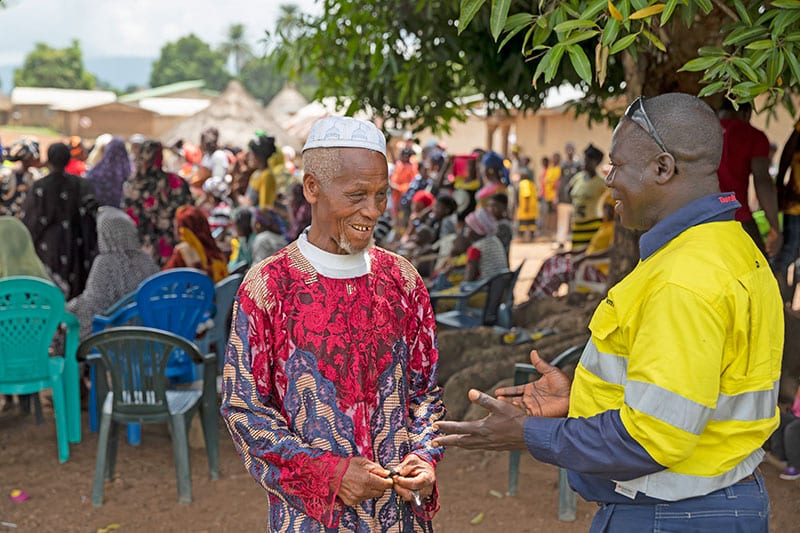
In mining, the workforce and the community are frequently the same population. Employees live in the villages the bursary scheme serves. Their children attend the school the mine built. Their relatives use the clinic. Every shift, several thousand people walk out of the gate and back into the community carrying whatever they understand about their employer.
That makes the workforce the highest-trust, highest-frequency communication channel any operation has – and the one most likely to be left out of the ESG engagement plan entirely.
When employees cannot describe what their company funds locally, the effect compounds in three directions.
The community loses its most credible source. People believe their neighbour before they believe a sign, a radio spot or a press release. If the neighbour who works at the mine cannot explain the community programme, no external channel will fill that gap convincingly.
Social performance teams lose motivation. The people running community projects rarely see their work recognised internally or externally. Work that is invisible starts to feel unvalued, and retention in these roles is already difficult.
Recruitment gets harder. Deloitte’s 2025 Gen Z and Millennial Survey, based on responses from more than 23,000 people worldwide, found that 70% consider a company’s environmental credentials and policies important when assessing a potential employer. Mining already competes for skills against sectors with easier locations and better perceived reputations. An operation that cannot describe its own social contribution hands that advantage away.
None of this requires new investment in community programmes. It requires that the people already on the payroll can accurately describe what the organisation does, in their own words, to the people they live among.

What gets in the way of internal ESG communication in mining
ESG community engagement in mining depends on a workforce that can actually be reached, and mining workforces are mixed-access by default. A minority sit at desks with company email. The majority are underground, in pits, in workshops, in vehicles, on rotation, or working shifts that never overlap with the working day of the comms team. Many use personal phones with limited data, or no smartphone at all. Several languages are usually in play on the same site.
Standard internal communication assumes none of this. An intranet post and an all-staff email reach the office population and stop there – which means ESG updates land with the people least likely to be having conversations in the community, and miss the people most likely to be having them.
The practical constraints that shape what works:
- Message has to survive being retold. If a supervisor cannot repeat it accurately at a pre-shift briefing, it will not travel.
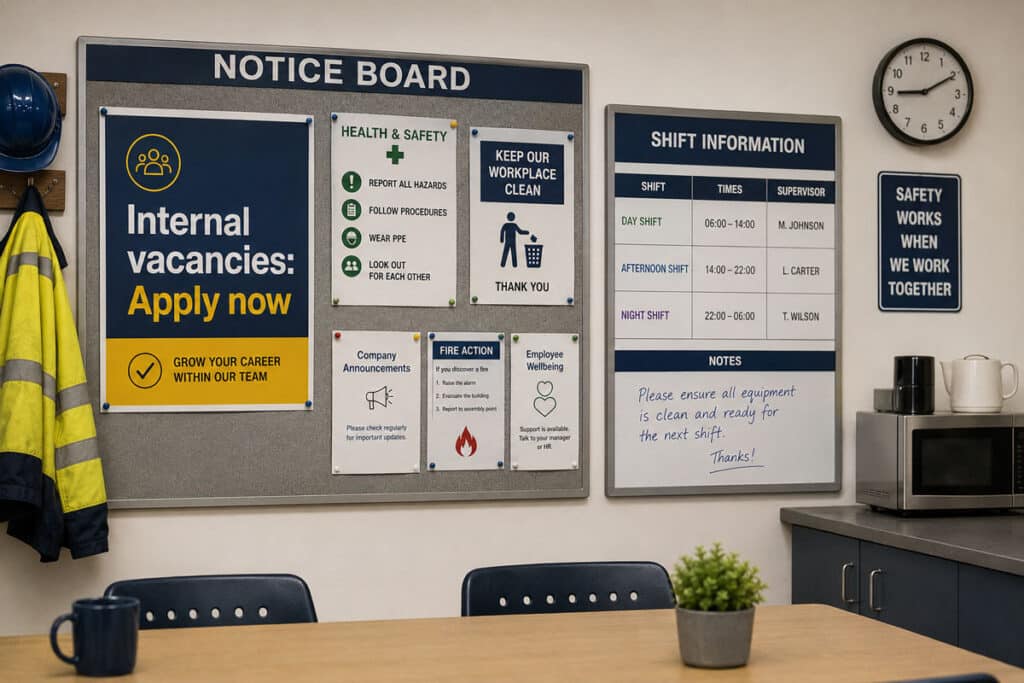
- Print still carries. Noticeboards, payslip inserts and canteen posters reach people that digital channels do not.
- Supervisors are the channel, not a bottleneck. Frontline leaders are the most trusted internal source, and they need material that is ready to use rather than another portal to check.
- Language coverage is not optional. Translation after the fact usually means the frontline receives the message weeks late, if at all.
Getting this right is the same discipline as running an effective safety programme, which is why operations with a strong internal health and safety campaign rhythm usually find ESG messaging easier to land. The channels already exist and the workforce already knows how to receive them.
How to build ESG community engagement in mining that people can see
Three stages, in order. None of them require a large budget to start.
Stage one: find out what people can actually name
Before planning any communication, establish the baseline. Ask employees and community members to name, unprompted, what the operation funds locally. Do not offer a list – recall matters more than recognition.
This does not need to be an expensive exercise. Structured conversations at pre-shift briefings and in community forums will surface the pattern quickly. In parallel, walk the projects. Photograph what is there. Count how many carry any attribution at all. A brand audit across a frontline workforce will usually find the same thing: significant investment, no visible signature.
Write down the gap between what has been funded and what can be named. That number is the brief.
Stage two: sequence the awareness work
Split it into short, medium and long term, and assign an owner to each.
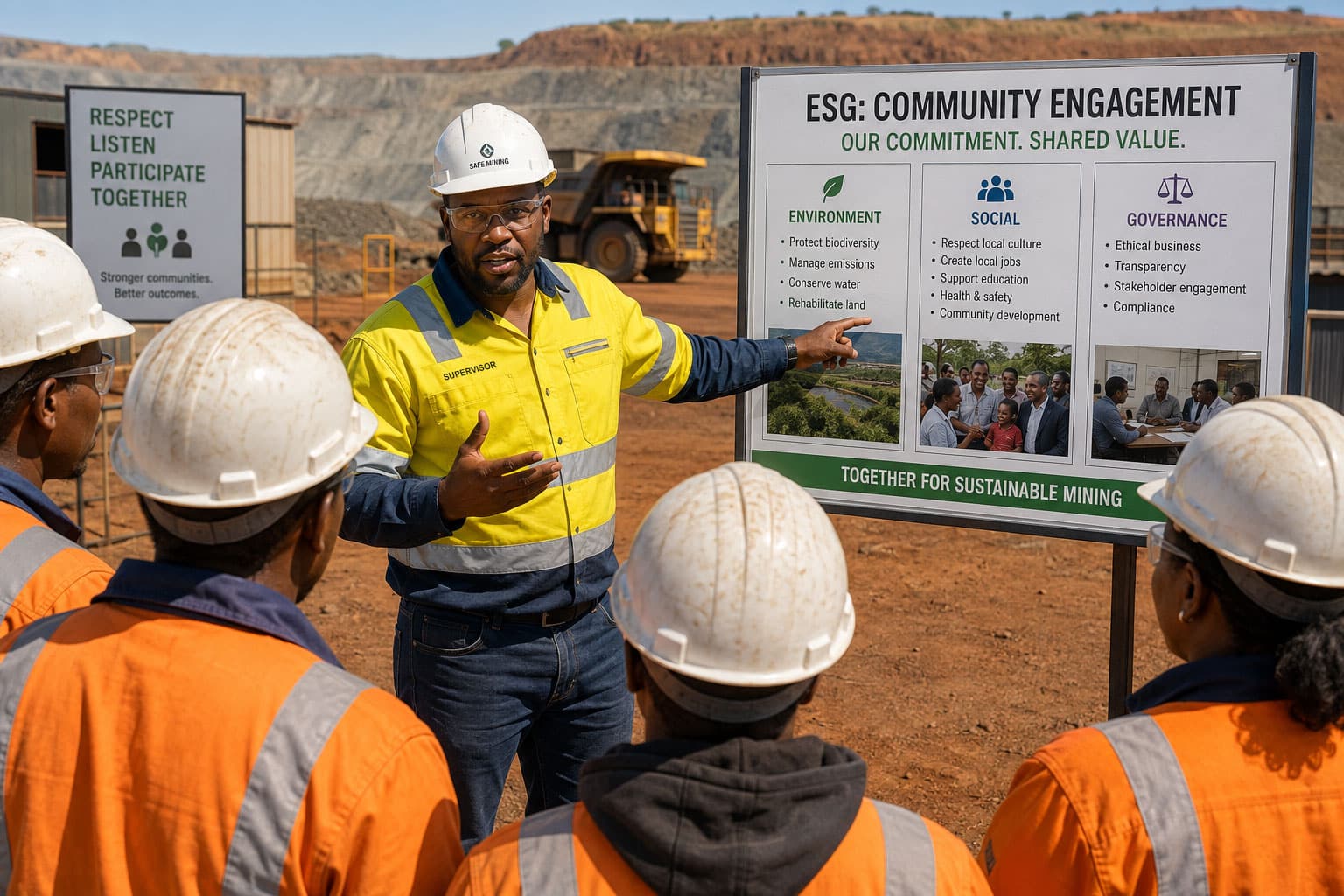
Short term is the visible correction – attribution on existing projects, a consistent way of describing the programme, and a briefing pack that lets supervisors explain it accurately. This is where most of the recall is won, and it is largely a design and distribution task.
Medium term is rhythm. Community and ESG stories become a standing item in the internal communications calendar rather than an occasional feature. Employees hear about the programme regularly enough to repeat it.
Long term is structure. Every new community project carries a communications plan from approval, not from completion, with a named owner for internal and community awareness.
Stage three: measure recall, then adjust
Return to the same questions after two quarters. Can more people name the projects? Has attribution shifted from “the government” or “someone” to the operation? Recall is the metric that matters, and it is the one almost nobody tracks.
Where recall has not moved, the usual cause is distribution rather than message. Check whether the material reached shift workers and contractors, or only the office. ESG community engagement in mining is judged on what people can repeat, not on what has been published.
Which channels carry ESG messages to a mixed-access workforce
Channel choice for ESG community engagement in mining follows the working day, not the org chart.
Site signage. A well-made sign at a funded project, and at the gate, is the cheapest permanent attribution available. It has to be designed and specified properly – a sign that rusts or fades within a year does more harm than no sign, because it reads as neglect. Signage manufacturers are specialists in production and installation, not in brand, and briefs need to reflect that.
Supervisor briefing material. Short, printed, in the relevant languages, designed to be read aloud in five minutes. In most mining operations this channel does more work than any other, and it is the one most consistently underinvested.
Physical spaces. Noticeboards in change houses, canteens and transport hubs. Low-technology, high-frequency, and they reach the people email does not.
A single internal home for the content. Somewhere employees can find the current version of what the operation funds, accessible on a personal phone without a corporate login. Without this, every message is disposable.
Local media partnerships. Community radio and local press reach households rather than just workers, and they cover the people who do not have a family member on site.
Digital and owned channels. The website ESG section, social channels and investor-facing material still matter for recruitment and reputation. Keep older community stories current – out-of-date content undermines the credibility of the accurate material sitting next to it.
Where honesty sets the limit
One boundary applies to all ESG community engagement in mining. Only communicate what is real.
Overstating community impact – greenwashing, or its local equivalent – is the single fastest way to lose the trust the whole exercise is meant to build. Communities have direct evidence. They know which clinic is staffed and which is not, which borehole works and which failed in year two. A claim that does not match what people can see does more damage than silence, and it is close to impossible to recover from.
The same applies internally. Employees who work on these projects know exactly where the gaps are. Ask them to repeat a version that overstates the position and they will disengage from the message entirely.
Accuracy is not a constraint on this work. It is what makes it credible enough to be repeated.
A practical checklist
Use this to assess where an operation currently stands on ESG community engagement in mining:
- Can a randomly selected employee name three things the operation funds in the local community?
- Does every funded project carry visible, accurate, well-maintained attribution?
- Do supervisors receive material about community projects in a form they can use at a briefing?
- Is community and ESG content available in the languages spoken across the site?
- Is there a single place a frontline employee can find current information without a corporate login?
- Does every new community project have a named owner for internal and community awareness from approval, not completion?
- Is recall measured – with employees and with the community – at least twice a year?
- Is older published ESG content still accurate?
Any question answered “no” points at a specific, fixable gap rather than a strategic failure.
Bringing it together
ESG community engagement in mining is not usually held back by insufficient investment or weak intent. It is held back by the absence of a system that carries the evidence to the people who need it – starting with the workforce that lives in the community and ends up speaking for the operation whether it is briefed or not.
This is the work CommsKit is built for: a managed service that gives large, mixed-access workforces a consistent internal communications rhythm through ENGAGE, and a branded place to find current information through CONNECT, without the comms team having to run it all themselves. If you are working through this in a mining or energy operation, then CommsKit is a good place to start.
Managing internal communications for large workforces is hard.
CommsKit™ makes it easier.
Disconnected people makes workplaces less safe and businesses less productive.
CommsKit has a managed solution that solves this challenge – consistently and on brand.

Discover ENGAGE →
A managed monthly communications programme – brand-aligned campaigns created, designed, and delivered on a fixed calendar. Your team approves. We do the rest.

CONNECT
Managed digital employee communications hub


ONBOARD
A consistent, repeatable onboarding system