
Why your employee benefits go unused (and how to fix the communication)



TLDR: Benefits uptake is low not because employees are disengaged, but because employee benefits communication is typically treated as a one-off announcement rather than an ongoing rhythm. What changes the outcome is timing: reaching people with the right benefit at the moment it is relevant to them, through a channel they actually use.
Every year, HR and reward teams invest in benefits packages they are proud of. They negotiate supplier contracts, model the cost-to-employer, and write a solid launch communication. Then, six months later, uptake is low and nobody can quite explain why.
Employee benefits communication is one of the most consistent frustrations in reward management – not because the benefits are wrong, but because the communication system that surrounds them was never designed to last beyond day one. A launch email is a broadcast, not a programme. Awareness built in week one will have decayed significantly by week ten, let alone by the time a life event actually makes a benefit relevant.
The problem is not that employees are ungrateful or disengaged. It is that organisations have no reliable way of keeping benefits recallable across a distributed, busy workforce, many of whom never sit at a desk or see a company intranet. Awareness fades. Context changes. And the benefit that felt relevant on induction day may not be the one an employee needs two years later.
This guide covers why uptake stalls, what to check before you communicate harder, and how to build an employee benefits communication rhythm that works throughout the year – not just at launch.
Why don’t employees use the benefits they’re offered?
Employee benefits communication is typically treated as a one-off task: design the package, announce it, post it on the intranet, and move on. The assumption is that once told, employees will remember.
They don’t. Awareness decays. Research from Totaljobs published in March 2026 found that only 39% of businesses feel confident their employees clearly understand the benefits available to them – despite the majority of those businesses having communicated them at some point. Understanding and recall are not the same thing, and neither is the same as uptake.
A few factors explain why the gap persists. Benefits packages are announced at volume but are rarely revisited in context. The joining pack mentions the EAP; no one mentions it again until a colleague posts about burnout on an internal channel two years later. The cycle-to-work scheme gets a launch email in April; by the time a new starter joins in October, it has not been mentioned since. This is not a benefits design failure. It is a communication architecture failure.
The CIPD’s 2026 reward survey, which polled over 1,000 UK HR and reward decision-makers, found that only a third of employers who review benefits against their objectives say those benefits fully meet their aims. Fifteen per cent do not review at all. There is a gap between intent and result that better communication design – not more communication – is most likely to close.
Is it really a communication problem? (The relevance and access check)
Before increasing the frequency of employee benefits communication, it is worth asking whether the benefit itself fits the workforce receiving it.
Low uptake is sometimes a communication problem. But it is also sometimes a relevance problem, an access problem, or a combination of both – and more communication will not fix either of those.
A cycle-to-work scheme means nothing to a shift worker who drives 40 minutes to a remote site. A private GP app is valuable in theory, but useless in practice if an employee’s phone is a personal device and the IT policy makes registration difficult. A wellbeing allowance will sit unclaimed if the process for claiming it requires a desktop browser, a login employees have forgotten, and a three-week approval window.
A short relevance-and-access audit before any benefits communication push asks three questions. First: does this benefit fit a meaningful proportion of the workforce it is targeted at? Second: is the route to access actually simple – and have you tested it as an employee, not as an administrator? Third: is there a group of employees – frontline, remote, deskless – for whom the standard communication route (email, intranet) simply does not exist?
If the audit surfaces a relevance gap, the right response is to review the benefit, not redouble the communication. If it surfaces an access barrier, the right response is to fix the barrier. Communicating harder around a broken access route frustrates employees and damages trust in future communications.
What “benefits awareness” actually requires
Benefits awareness is not a state you can create once. It is something that needs active maintenance – because life changes, memory fades, and new starters join throughout the year with no connection to last April’s launch email.
There is a useful distinction between declarative awareness and activated awareness. Declarative awareness is knowing a benefit exists. Activated awareness is knowing the benefit exists and understanding how to use it at the moment it is relevant. Most employee benefits communication creates the former and stops there. Closing the gap requires communication that is timed to moments of relevance, not just to the benefits calendar.
Moments of relevance in the employment lifecycle are fairly predictable: the first week of employment, the pay review period, any personal or family life event, renewal windows, and year-end, when employees are often reflecting on whether the job is still right for them. These are the moments when a benefit lands – when it connects to something the employee is actively experiencing, rather than arriving as background information they are expected to file for later.
This is why onboarding communication design matters so much for benefits uptake. Overloading new starters with benefits information on day one – when they are still learning where the bathrooms are – is one of the most common ways organisations squander the moment when employees are most attentive to what the organisation offers.

How to keep benefits front of mind without nagging
The risk of over-communicating is real and is worth naming directly. Sending the same benefits reminder every quarter trains employees to filter it out. If every communication looks the same, arrives at the same time, and says the same thing, it becomes wallpaper. Employees learn to ignore it, and HR’s ability to cut through on time-sensitive communications suffers as a result.
The difference between a well-timed benefits communication and a nagging one is context. A well-timed communication connects a specific benefit to a moment the employee is actually experiencing. “It’s pay review season – do you know how much your total reward package is actually worth?” is different from “Reminder: here are your benefits.” One invites engagement. The other requests filing.
Benefits communication also works better in short doses than in comprehensive catalogues. A monthly push that highlights a single benefit in plain terms will outperform an annual brochure that lists 18 benefits in six pages. The test is not completeness; it is recallability.
Where benefits are varied and audience-specific, segmentation matters. A benefit relevant to employees with caring responsibilities does not need to reach the entire organisation. Targeted communication reduces noise and increases the likelihood that the people who can actually use the benefit hear about it clearly.
Reaching frontline and deskless staff who never see the benefits portal
The standard benefits communication infrastructure – email, intranet, self-service portal – was built for desk-based employees. It works reasonably well for that audience. It works poorly, and sometimes not at all, for frontline and deskless workers who have no regular access to a company device or shared network.
In large organisations with mixed workforces, this creates a structural two-tier system where a significant proportion of employees are functionally excluded from benefits awareness, regardless of what the package contains. A warehouse operative, a healthcare assistant, or a field engineer who clocks on and off via a physical device will rarely encounter a benefits portal without a deliberate effort to reach them differently.
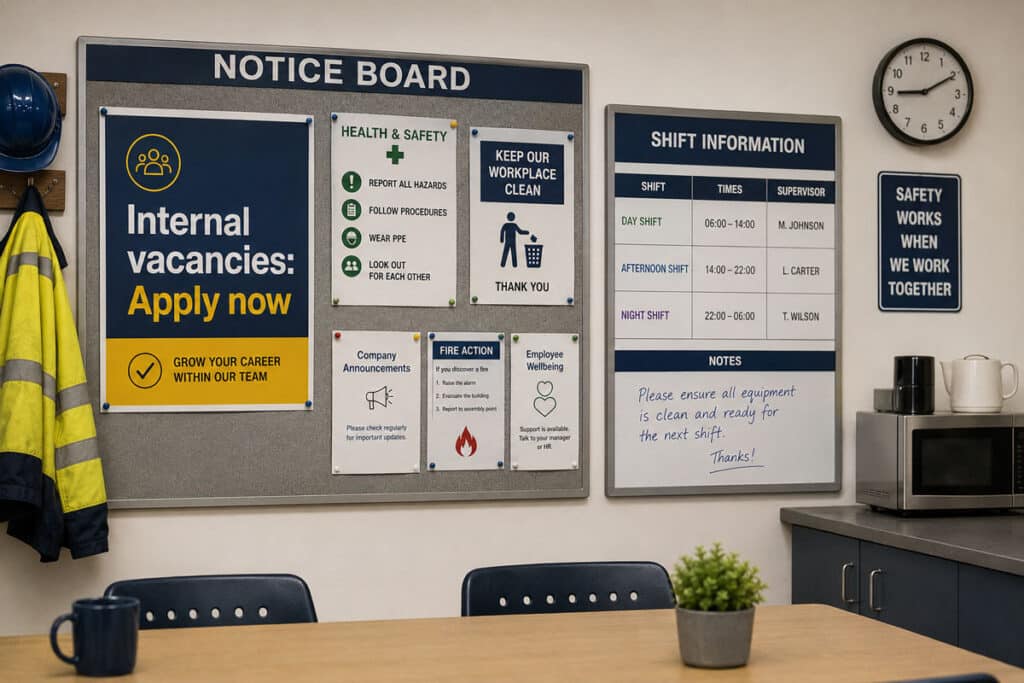
The right approach for deskless staff combines short formats, trusted channels, and timing that fits the working day. Manager briefings, printed one-pagers in break rooms, shift-start prompts, and SMS or WhatsApp where appropriate are all more effective than directing frontline staff to a URL they may never visit. The message itself needs to be shorter and the action simpler: one benefit, one clear step to access it, one person to ask.
This does not require a separate communication strategy. It requires an additional communication route – one that runs in parallel with the digital-first approach and is designed specifically for the realities of shift work, high-turnover environments, and limited screen time.
A practical employee benefits communication calendar
A 12-month employee benefits communication calendar structures the rhythm around moments that matter, rather than around what is easiest for HR to produce. Below is a working framework.
January – Pay review and total reward
Tie benefits communication to pay conversations. This is the moment employees are most likely to be evaluating their overall package. A total reward statement – even a simple one – makes visible what many employees do not consciously count.
April – Post-enrolment check
Where benefits have an annual enrolment window, follow up after the deadline closes. Employees who missed the window should know what they can still access. Employees who enrolled should know what they have signed up for.
June / July – Wellbeing and summer moments
Highlight wellbeing, EAP, and annual leave-related benefits ahead of the summer period. Life events cluster around holiday season and return-to-school.
September – Return-to-school and back-to-work
Childcare, financial wellbeing, and learning and development benefits resonate in this window, particularly for parents and employees who tend to reflect on direction after the summer.
October / November – Renewal and open enrolment
This is the most active benefits window for many organisations. Communication should begin at least four weeks before the deadline and be staged – awareness first, then action.
December / January – Year-end reflection
End-of-year is a moment employees consider whether to stay. A well-timed communication about financial, health, or flexible working benefits can connect the package to the question of retention without needing to name it directly.
For frontline and deskless staff, each of these moments needs a parallel channel: a one-page printed summary, a team briefing prompt, or a direct manager message. The medium changes. The moment does not.
Good benefits communication is not about reminding people more often. It is about showing up at the right moment, through the right channel, with one clear message about one benefit that is actually relevant to where that employee is right now. That is the difference between a benefits programme employees engage with and one they vaguely know exists.
If you are thinking about how to build that kind of communication rhythm across a distributed workforce, CommsKit is a good place to start. Let’s chat.
Managing internal communications for large workforces is hard.
CommsKit™ makes it easier.
Disconnected people makes workplaces less safe and businesses less productive.
CommsKit has a managed solution that solves this challenge – consistently and on brand.

Discover ENGAGE →
A managed monthly communications programme – brand-aligned campaigns created, designed, and delivered on a fixed calendar. Your team approves. We do the rest.

CONNECT
Managed digital employee communications hub


ONBOARD
A consistent, repeatable onboarding system