
What a brand audit for frontline workforces reveals



TLDR: A brand audit for frontline workforces looks at the places most audits never reach – the gatehouse, the muster point, the noticeboard, the bus. Standard brand audits measure customer perception, so they miss the version of your brand that thousands of employees actually live with every shift. What changes the outcome is auditing on site, asking the people who work there, and treating what you find as a system problem rather than a design problem.
The gap between how an organisation describes its brand and how that brand is experienced on a mine site, in a depot or on a factory floor is usually much wider than anyone at head office expects.
It is rarely anyone’s fault. Brand guidelines get written for the audiences the marketing team can see – customers, investors, the press, candidates browsing a careers page. Those guidelines are thorough. They are also almost entirely silent on what happens when a contractor arrives at a remote gate at four in the morning and has to work out where to go.
Meanwhile the brand keeps expressing itself anyway. It expresses itself through a laminated sign that has been in the sun for six years. Through a safety notice printed in a typeface nobody chose. Through a bus that says one thing, a uniform that says another, and a toolbox talk that references a value statement half the crew have never seen.
Gallup’s research on employee brand alignment found that only 41% of employees strongly agree they know what their company stands for and what makes its brand different from competitors – and that figure drops as you move away from the executive floor, to 46% among managers and 37% among other employees. Gallup’s analysis of employee brand understanding puts the problem plainly: the further someone sits from the centre, the less of the brand reaches them.
A brand audit for frontline workforces is how you find out what is actually reaching them.
What is a brand audit for frontline workforces?
A brand audit for frontline workforces is a structured assessment of how an organisation’s brand is experienced by people who work without a desk, without a company email address, or without reliable digital access. It covers the physical environment, the printed and displayed material, the communication channels in use, and what employees, contractors and surrounding communities believe about the organisation.
It differs from a conventional brand audit in one respect that changes everything else. A conventional audit asks how customers perceive the brand. This one asks how the workforce perceives it – and then treats the answer as an operational finding, not a marketing one.
That distinction matters because in a distributed organisation the workforce is the brand’s largest and most frequent audience. A mine with 3,000 employees generates more brand impressions in a week among its own people than its corporate website does in a year.
Why most brand audits stop at the office door
A brand audit for frontline workforces has to begin somewhere other than the standard framework. Those frameworks were built for consumer and B2B marketing. They examine logo usage, tone of voice, website performance, campaign effectiveness and competitor positioning. All of that is useful. None of it goes to site.
So the audit report comes back clean while, three hundred kilometres away, the induction room still carries the previous parent company’s logo.
Three things tend to go unexamined:
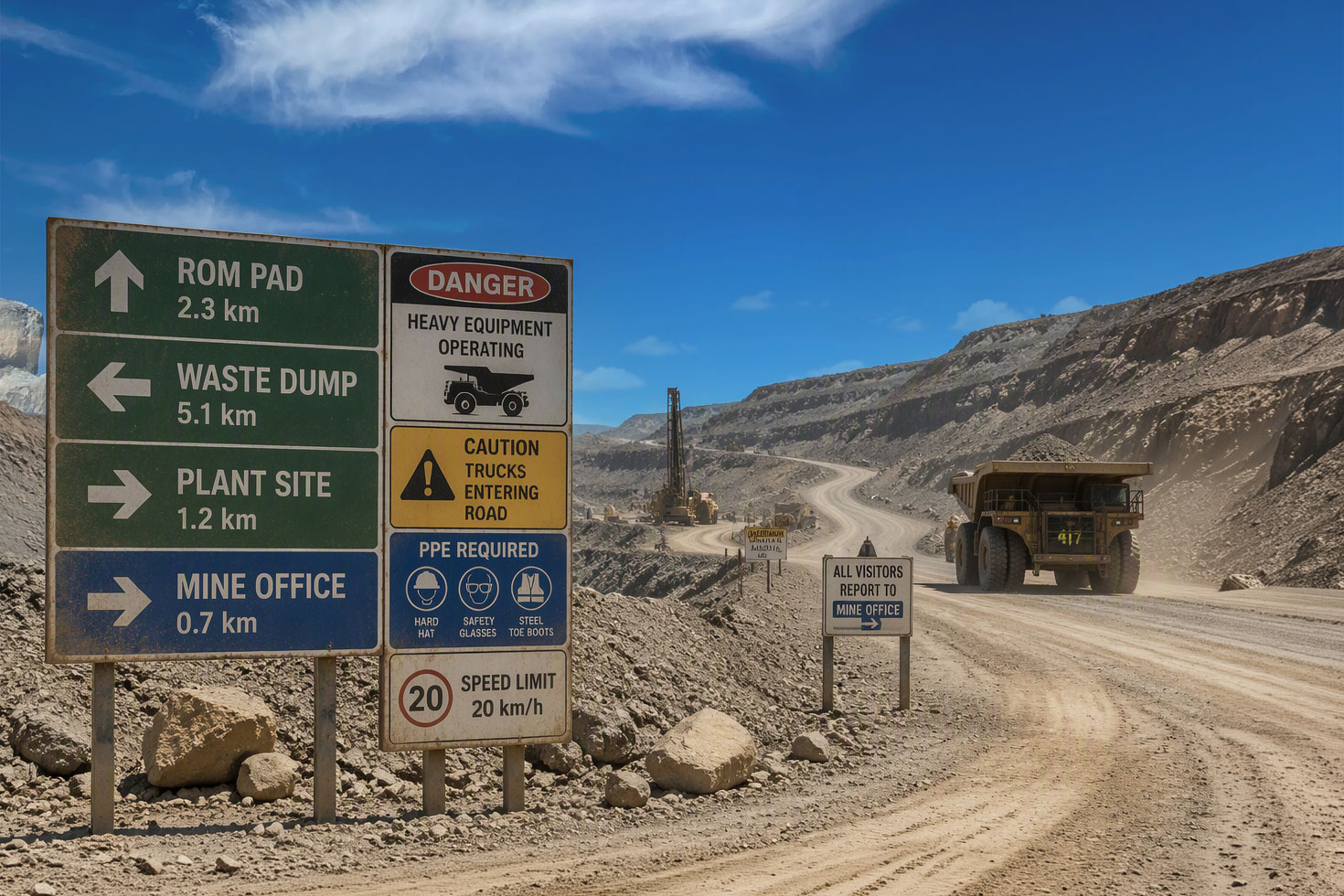
The physical estate. Signage, wayfinding, gatehouse and reception, vehicle livery, workwear, hoardings, noticeboards, muster points, canteens, change rooms. These are the highest-frequency brand touchpoints in the organisation and they are almost never in scope.
Non-digital channels. Printed notices, toolbox talks, shift handovers, supervisor briefings, SMS, radio, WhatsApp groups that grew organically and nobody owns. If the audit only reviews the intranet, it reviews the channel the frontline uses least.
The perception of people who are not customers. Contractors, seasonal workers, families, neighbouring communities. In resource sectors these groups shape reputation more directly than any campaign does.
What the on-site audit actually looks at
The on-site component is what separates a brand audit for frontline workforces from a desk exercise. It typically runs two to five days per site, walking the route an employee, contractor or visitor walks.
First impressions and wayfinding
The approach road, the gate, the security process, the reception area, the visitor induction. What does someone arriving for the first time see, and how long does it take them to work out where to go? Confusing wayfinding is usually read as disorganisation, and disorganisation is read as a safety signal.
Safety and compliance signage
Condition, currency, legibility, language coverage and consistency. Safety signage is where brand and risk meet, which is why it is worth auditing properly rather than folding into a general design review. Our work on internal health and safety campaigns covers the campaign side of this in more depth.
Workwear, vehicles and equipment
Uniform standards across employees and contractors, vehicle livery, PPE branding, equipment marking. Inconsistency here is the most visible signal of a brand nobody is holding.
Communication points
Noticeboards, digital screens, canteen displays, change room boards. What is on them, how old it is, who is responsible for changing it, and whether anyone stops to read.
Asset and template control
Where site teams get their templates, what versions are in circulation, whether there is a brand library and whether anyone can reach it from a site with poor connectivity.
What the perception survey surfaces
The physical audit tells you what the brand looks like. The perception survey tells you what it means. It usually runs across four groups: employees, contractors, stakeholders and surrounding communities.
The findings are often uncomfortable, and they are usually the most valuable part of the report. Employees will describe the organisation in language that bears no relation to the value statement in the annual report. Contractors will describe a two-tier experience. Communities will describe a relationship built on whatever they heard last.
None of this reflects badly on the comms team. It reflects the absence of a system for keeping a distributed workforce aligned – which is a design problem, not a diligence problem.
The survey also identifies which channels actually work. Organisations regularly discover that the channel they invest in most is the one their frontline uses least, and that a supervisor briefing they never formalised is carrying most of the load.
What a systems review covers
The third component looks at how site communications get made. Who produces material, what they use, what they wait for, and where things stall.
This is where the audit stops being a critique and starts being useful. Common findings include a single overloaded person acting as an informal brand custodian, no route for site teams to request material, templates that were never distributed beyond head office, and approval chains that make it faster to improvise than to comply.
Those findings connect directly to the ones from the physical audit. The sign that has been in the sun for six years is not there because nobody cares. It is there because there is no process for replacing it.
What usually comes back in the report
A brand audit for frontline workforces should produce something more useful than a document. In practice the output has four parts:
- A findings summary – what was observed on site, what the surveys returned, and where the physical and perceptual evidence agree or diverge.
- A prioritised action list – ranked by risk, visibility and effort. Non-compliant safety signage sits above vehicle livery.
- A systems recommendation – what needs to exist so the same findings do not recur in two years.
- A feedback session – findings presented to key stakeholders with the reasoning visible, so decisions can be made in the room.
The prioritisation is the part that gets used. Most organisations already suspect a good deal of what the audit finds. What they lack is a defensible order of work and a case for funding it.
What happens after a brand audit for frontline workforces?
The audit identifies the gaps. Something else has to close them.
That usually splits into two streams. The immediate corrections – signage, templates, workwear standards, channel tidy-up – are finite pieces of work with a clear end point. The structural gap is different: if the audit found that no system exists for keeping a distributed workforce aligned, buying new signage will not fix it.
This is where BrandKit comes in. It is the foundational layer – positioning, messaging framework and visual identity system – that gives the corrections something to be consistent with. An audit without that layer produces a tidier version of the same problem within about eighteen months.
Where an audit finds the foundation is sound and the issue is reach and rhythm, the answer lies elsewhere in the suite. ENGAGE handles consistent campaign delivery; CONNECT handles findability. Which route applies is a question the audit answers rather than assumes – and it is worth reading our view on internal comms trends alongside it, because the trap is buying a tool before you know which gap you have.
Run a first pass yourself
You do not need an external audit to start. A structured self-assessment will surface enough to tell you whether a full audit is warranted, and it costs a morning.
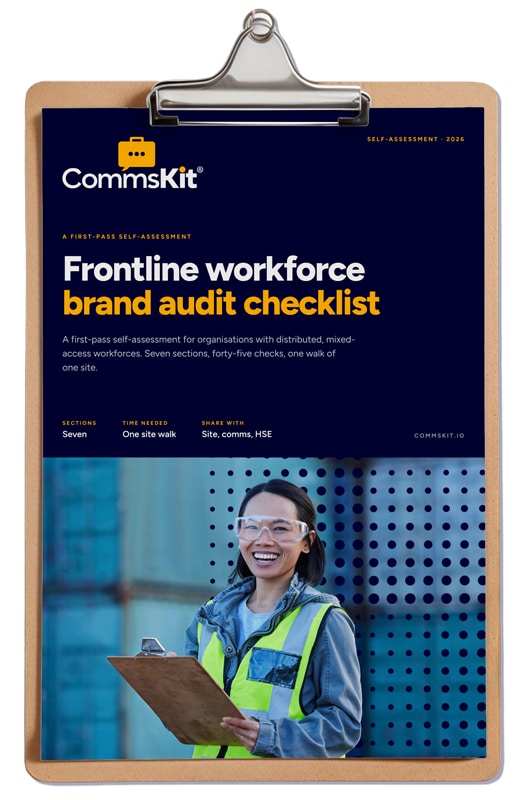
Our frontline brand audit checklist covers the same ground in question form – physical estate, signage, channels, perception, asset control and governance – grouped so you can hand sections to different people. Walk one site with it before you commission anything.
Two caveats worth stating. A self-audit is honest about what you can see and blind to what you are used to; the value of an external pass is largely that it has not stopped noticing. And a self-audit cannot run a perception survey, which is where the findings usually are.
Common questions
How long does a brand audit for frontline workforces take?
On-site work typically runs two to five days per site. Perception surveys and analysis add several weeks depending on how many groups are covered and how dispersed they are.
Do you need to audit every site?
No. A representative sample usually surfaces the systemic issues. Sites differ in condition but rarely in cause, and the cause is what the report needs to identify.
Is this the same as an employee engagement survey?
An engagement survey measures how people feel about working for the organisation. A brand audit for frontline workforces measures what the organisation is communicating and whether it is landing. The two are related and answer different questions.
Should the audit be done internally or externally?
Internal teams know the operation and cannot see what they have normalised. External auditors see clearly and know less. The practical answer is usually external assessment with internal guidance – the outside pass provides the observation, the inside team provides the context.
What if the findings are bad?
They usually are, in parts, and that is the point of commissioning one. Findings describe a system that was never designed rather than a team that failed. Reports that come back entirely positive are generally reports that never left the office.
A brand audit for frontline workforces is not a design exercise. It is a way of finding out what the largest audience you have is actually receiving – and then deciding, with evidence, what to do about it.
If that is the question in front of you, commskit.io is a good place to start. Talk to us if you’re ready to take your internal brand to the next level.
Managing internal communications for large workforces is hard.
CommsKit™ makes it easier.
Disconnected people makes workplaces less safe and businesses less productive.
CommsKit has a managed solution that solves this challenge – consistently and on brand.

Discover ENGAGE →
A managed monthly communications programme – brand-aligned campaigns created, designed, and delivered on a fixed calendar. Your team approves. We do the rest.

CONNECT
Managed digital employee communications hub


ONBOARD
A consistent, repeatable onboarding system