
Internal Comms Trends in 2026



Top Trends for Internal Comms in 2026
TLDR: Internal communications trends often focus on new tools and tactics, but the real challenge is consistency and clarity. Without structure, trends add complexity rather than value. The organisations seeing the most impact are those using trends to support a clear, systemised communication approach, not replace it.
Clear internal communication is critical to organisational performance – especially in complex, distributed workforces. As organisations look ahead, internal comms trends in 2026 are increasingly shaped by the need for structure, consistency and scale. It enables information to flow between teams, sites and leaders so that people understand what matters, what’s changing, and what’s expected of them.
At CommsKit, we see internal communication not as a series of one‑off messages, but as a system. This approach reflects a systemised internal communications model designed for organisations with complex, multi‑audience workforces. In 2026, that system‑led thinking is shaping how organisations communicate at scale.
Below are eight internal comms trends for 2026 we’re seeing gain real traction – and where organisations are focusing their efforts.
What counts as internal communication?
Internal communications includes any structured way an organisation shares information, guidance and direction with its workforce. This can include:
- Awareness and behaviour‑change campaigns
- Employee education and training content
- Policies, procedures and guidelines
- Leadership updates
- Instant messaging and collaboration tools
- Email and newsletters
- Intranets, hubs and internal platforms
- Digital screens and on‑site communications
In 2026, the shift is less about adding more channels – and more about using the right mix, consistently.
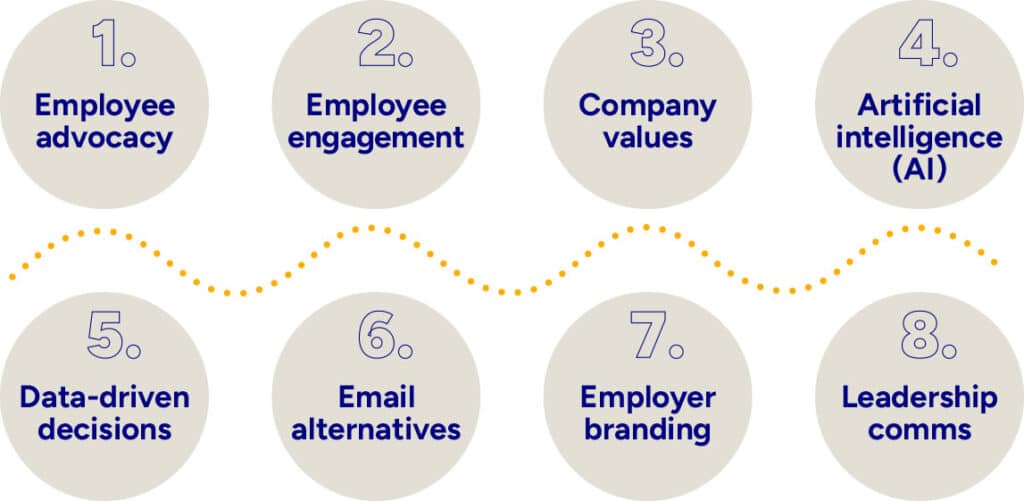
Internal communications trend #1: Employee advocacy
Employee advocacy is when employees reinforce the organisation’s message – internally first, and externally where appropriate.
This can include employees sharing company content, contributing insight, or supporting key messages in day-to-day work. When employees create content themselves, this is often referred to as employee-generated content (EGC).
Thought leadership and employee voices
In internal comms, thought leadership doesn’t need to be polished or public-facing. It’s often most effective when it’s practical and grounded.
Examples include:
- A safety manager explaining the reasoning behind a new procedure.
- An operations lead sharing what’s changed on site and why it matters.
- HR translating complex policies into plain language and real scenarios.
Credibility comes from experience and relevance, not production quality.
Encouraging advocacy
- Make messages easy to understand and share.
- Keep participation voluntary, not performative.
- Reinforce behaviour internally before expecting it externally.
- Recognise contribution without turning it into obligation.
Advocacy works when employees genuinely understand and believe the message.
A note on social media sharing
External sharing should be a by-product of strong internal communication, not the objective. Some employees will naturally choose to share content externally – particularly leaders or specialists – but this should remain optional and supported with light guidance, never mandated or used as a substitute for internal channels.
Internal communications trend #2: Employee engagement
Employee engagement is about connection – to purpose, to leadership, and to daily work.
Most workforces fall into three broad groups:
- Engaged employees
Motivated, committed and proactive. They understand how their work contributes to the bigger picture. They want to come to work. - Disengaged employees
Disengaged employees have no energy or passion for their job and they do the minimum. Energy and commitment have dropped. Getting to work is a struggle as well as the tasks they perform. - Actively disengaged employees
Openly unhappy and often disruptive to others. They openly show their unhappiness, demotivate engaged workers, and have no interest in performing any work-related task.
Engagement tends to decline when communication becomes inconsistent, unclear or purely transactional.
Keeping employees engaged requires ongoing effort and conversations. Are you doing the following:
- Giving clear expectations
- Giving them the tools they need to perform their job
- Giving them the opportunity to excel
- Regularly recognising employees for a job well done
- Genuinely caring about employees’ well-being
- Listening to and implementing their ideas
- Making them feel valued
- Giving them opportunities to learn and grow
How organisations are improving engagement in 2026
- Using simpler, more accessible language
- Matching messages and building trust to the audience… not the org chart
- Listen to your employees’ needs and take action where you need to. Be sure not to overdo it with surveys as you don’t want employees experiencing survey fatigue
- Being explicit about behaviour, safety and conduct standards
Systemised communication plays a major role here – engagement drops quickly when messages feel random or reactive.
Internal communications trend #3: Company values in action
Values only matter if employees see them applied – not stated once, but demonstrated repeatedly. Employees judge values through everyday decisions, leadership behaviour and what is tolerated when pressure is on. When values only appear in presentations or onboarding packs, credibility erodes quickly.
In 2026, organisations are moving beyond posters and statements, and instead:
- Reinforcing values through regular campaigns
- Linking values to real decisions and behaviours
- Using leadership communication to model them
Internal comms is the mechanism that keeps values visible, relevant and credible – particularly in operational environments where culture is shaped day‑to‑day.
Internal communications trend #4: Artificial intelligence (AI)
AI is increasingly used to support internal communications – not replace it. In 2026, the most effective use of AI sits behind the scenes, strengthening consistency, speed and quality without removing human judgement.
Practical AI in internal comms use cases include:
- Drafting and adapting core messages for different audiences, literacy levels or sites – while keeping the underlying message consistent.
- Reducing admin and repetitive tasks such as reformatting content, summarising long updates, or preparing manager-ready talking points.
- Supporting managers who aren’t natural communicators with clearer language, structure and confidence.
Tools such as LOOP are increasingly used to close the feedback gap. By capturing recurring questions, sentiment and engagement patterns, organisations can see where messages are landing – and where they’re not – and adjust future communication accordingly.
A note on thoughtful and secure AI use
AI must be approached deliberately. The organisations seeing real value are those that:
- Apply AI within defined communication frameworks, not as a shortcut.
- Control what data is input, stored and reused.
- Use secure, approved tools rather than public or unmanaged platforms.
- Treat AI as an assistant, not a decision-maker.
Without governance, AI can introduce risk – from inconsistent messaging to data exposure. With the right structure, however, it becomes a powerful enabler of clarity and scale.
The difference is not the technology itself, but how intentionally it is applied.
Internal communications trend #5: Data‑driven insight
Internal comms teams are using data to understand:
- Which channels are actually being used
- What content is seen, ignored or misunderstood
- Where engagement drops off
Practical examples include:
- Identifying that frontline teams rarely open long emails, but consistently engage with short screen messages or WhatsApp-style updates – prompting a shift in format rather than more reminders.
- Spotting repeated questions after a policy launch, indicating the message was delivered but not understood, and triggering a follow-up explainer or manager talking points.
- Seeing engagement drop after week two of a campaign, and using that insight to adjust timing, frequency or creative before fatigue sets in.
Increasingly, AI-supported tools are helping internal comms teams interpret this data faster and more accurately. Rather than manually reviewing feedback, sentiment and usage patterns, teams can identify themes, risks and blind spots earlier – and respond before issues escalate.
This data-driven approach turns internal communication into a continuous improvement process, where each campaign informs the next. Insight replaces assumption, and communication evolves based on how employees actually experience it – not how it was intended.
Internal communications trend #6: Reducing email dependency
Email still has a role – but it’s no longer the default. Over‑reliance on inbox communication often leads to missed messages, uneven understanding and fatigue, particularly in operational and frontline environments.
In 2026, organisations are:
- Using digital screens for high‑visibility messaging in shared spaces where attention already exists
- Reinforcing key messages across multiple touchpoints rather than relying on a single send
- Designing content specifically for frontline environments, where time, access and literacy levels vary
- Using a dedicated employee communication hub (such as CommsKit CONNECT) for workers who can’t rely on email but still need a single, trusted place to access news, updates and essential information
Practical shifts include breaking long email updates into short, visual messages, pairing digital content with manager-led conversations, and repeating critical information across channels over time.
The goal is not fewer messages, but clearer ones – seen in the right place, at the right time, and reinforced often enough to be understood.
Internal communications trend #7: Employer branding from the inside out
Employer branding starts internally.
Strong internal comms:
- Align what employees experience day to day with what is promised externally
- Support attraction and retention in competitive markets by reducing uncertainty and churn
- Reduce the gap between culture statements and lived reality
- Extend employer branding into induction and onboarding (see CommsKit ONBOARD) – ensuring recruitment promises are reflected from day one and reinforced through everyday communication.
Practical examples include consistent induction messaging across sites, clear communication around progression and development, and leaders reinforcing the same behaviours internally that are showcased in recruitment campaigns.
Organisations known for strong employer brands invest heavily in internal communication consistency – not just recruitment marketing. They treat internal comms as a long-term capability that shapes reputation from the inside out.
Internal communications trend #8: CEO and leadership communication
Employees expect visibility and clarity from leadership.
In 2026, effective CEO communication is:
- Regular, not occasional
- Direct and human, not overly scripted
- Linked to what employees are experiencing on the ground
Short, frequent updates often outperform polished monthly messages.
Internal comms trends – bringing it together
None of these trends are particularly complex on their own. The challenge is consistency.
This is where a systemised internal communications model matters. When messaging is planned, repeatable and aligned, organisations see stronger engagement, better understanding and less noise.
CommsKit exists to make that system practical – turning internal communication from a constant scramble into a structured, predictable programme that works at scale. Explore the full CommsKit suite and how it supports modern internal comms trends: https://commskit.io/solutions/.
For further perspective on employee engagement, communication and workplace trends, research from McKinsey (https://www.mckinsey.com/capabilities/people-and-organizational-performance/our-insights) and Gartner (https://www.gartner.com/en/human-resources/insights/employee-experience) provides useful external insight.
Managing internal communications for large workforces is hard.
CommsKit™ makes it easier.
Disconnected people makes workplaces less safe and businesses less productive.
CommsKit has a managed solution that solves this challenge – consistently and on brand.

Discover ENGAGE →
A managed monthly communications programme – brand-aligned campaigns created, designed, and delivered on a fixed calendar. Your team approves. We do the rest.

CONNECT
Managed digital employee communications hub


ONBOARD
A consistent, repeatable onboarding system