
AI in communications: Strategy first, tools second




AI in communications: Strategy first, tools second
This article builds on insights shared by Louise Cunningham, co-founder of CommsKit and Halo Media, during her interview contribution to the PRCA AI Green Paper: Setting the Standard for Responsible AI. It reflects a practitioner’s perspective of AI in communications. Shaped by multiple technology shifts in communications, Louise focuses on what responsible, human‑led AI adoption actually looks like in real-world comms environments.
TL;DR: AI will become mainstream in communications – whether we like it or not. The real risk isn’t AI itself, but unstructured adoption or opting out entirely. The most resilient comms teams will be those that adopt AI with clear intent, human-led accountability, and practical guardrails – focusing on outcomes, not novelty.
Artificial intelligence is not the first technology to disrupt the communications industry – and it won’t be the last.
I’ve been working long enough to remember when computers and the internet moved from “optional” to unavoidable. I watched that shift play out in real time: some people and companies adapted early and built momentum, others resisted or ignored it, and a third group tried to sit it out entirely.
The pattern was always the same.
Those who adapted didn’t necessarily have more talent – they had more willingness to learn.
Those who resisted weren’t less intelligent – they were uncomfortable with change.
And those who opted out altogether often lost relevance, not overnight, but gradually.
This context is why I was pleased to be interviewed and invited to contribute to the PRCA AI Green Paper on Responsible AI. The conversation wasn’t about shiny tools or efficiency hacks. It was about what AI means for trust, accountability and the future role of communications.
AI is not a communications strategy
One of the biggest mistakes I’m seeing in organisations right now is treating AI adoption as a tools problem.
Teams ask:
- Which AI platform should we use?
- Who’s trialling what?
- How fast can we roll this out?
These are the wrong starting points.
AI tools move too fast for tool-led strategies to make sense for very long. If you start with the tech, you’re usually already on the back foot. What matters much more is why you’re using AI, where it genuinely helps, and what you’re trying to improve.
Without that clarity, AI starts creating confusion — or worse, unnecessary risk.
In communications, that matters. This is a profession built on reputation, trust, clarity and public understanding. Moving faster without judgement doesn’t strengthen those things – it slowly erodes them.
The role of AI in communications
Communications professionals have a critical role to play in how AI is adopted – not just internally, but publicly.
As AI becomes more visible in customer experience, internal comms, content generation and decision-making, organisations need people who can:
- Explain how AI is being used, in plain language
- Sense-check accuracy, tone and cultural context
- Anticipate reputational and ethical risk
- Ensure accountability remains human, not abstract
AI is assistive, not autonomous. That distinction matters.
No model, however advanced, can replace ethical judgement, contextual awareness or responsibility. In practice, the most effective teams treat AI as a support layer – helping them work faster and more consistently – while keeping ownership firmly with people.
Start small. Stay consistent. Learn by doing.
From working with large, complex organisations – particularly in regulated or safety-critical environments – a clear pattern emerges.
The teams that succeed with AI don’t do more. They do less, better.
They:
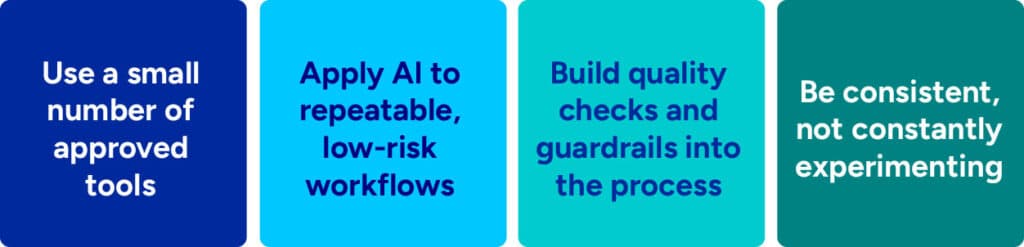
- Use a small number of approved tools
- Apply AI to repeatable, low-risk workflows
- Build quality checks and guardrails into the process
- Focus on consistency rather than experimentation for its own sake
This approach builds confidence, capability and trust – internally and externally.
It also avoids the common trap of AI theatre, where lots of activity masks a lack of real impact.
Why opting out is not a neutral choice
There’s a temptation to view resistance to AI as a principled stance. In reality, opting out is still a decision – and often a risky one.
History shows that when foundational technologies become mainstream, the people most negatively impacted are not those who adopt thoughtfully, but those who disengage entirely.
That doesn’t mean blind adoption. It means participation with intent.
If we want AI to strengthen the communications profession – rather than commoditise it – we need experienced practitioners involved in shaping how it’s used, governed and explained.
That was the spirit of the PRCA Green Paper, and why contributing to it mattered.
The opportunity ahead
AI in communications is here. The question is not whether it will change communications, but how responsibly we allow that change to unfold.
Handled well, AI can:
- Free up time for strategic thinking
- Improve consistency and accessibility
- Strengthen quality control
- Support better decision-making
Handled badly, it erodes trust, blurs accountability and weakens professional credibility.
At CommsKit, we take the long view of the role of AI in communications – but only when it is anchored in strategy, guided by ethics, and led by people who understand the responsibility that comes with influence.
Managing internal communications for large workforces is hard.
CommsKit™ makes it easier.
Disconnected people makes workplaces less safe and businesses less productive.
CommsKit has a managed solution that solves this challenge – consistently and on brand.

Discover ENGAGE →
A managed monthly communications programme – brand-aligned campaigns created, designed, and delivered on a fixed calendar. Your team approves. We do the rest.

CONNECT
Managed digital employee communications hub


ONBOARD
A consistent, repeatable onboarding system