
MINING INTERNAL COMMUNICATIONS CASE STUDY: RIO TINTO RBM
How Rio Tinto RBM aligned mining internal communications during an ownership transition

ABOUT
Following its acquisition by Rio Tinto, Richards Bay Minerals needed to align its local identity with global standards.
We delivered a brand-led change communications programme that unified the workforce under a single identity. By systemising internal channels and conducting site audits, we corrected brand drift and brought site communications onto a single, consistent system.
SECTOR
Mining & resources
WORKFORCE
5,000+
LOCATION
South Africa
Guinea
Madagascar
TLDR
CommsKit (then Halo Media) supported Rio Tinto RBM through a multi-year internal communications and brand alignment programme across mining operations in South Africa, Guinea, and Madagascar.
The work unified brand systems, systemised frontline communications for 5,000+ employees, and established governance frameworks that reduced brand drift during ownership transition.
Why ownership transitions put mining internal communications at risk
Ownership changes and global integration are common in mining. When assets change hands, local operations are often required to align quickly with new governance, brand and reporting standards – while continuing to operate in safety‑critical, community‑sensitive environments.
In these moments, mining internal communications are under pressure. What employees see, read and experience on site must reinforce stability, trust and clarity, not add confusion.
5,000 employees
3 countries
15+ year partnership
The mining internal communications challenge: identity drift
When Richards Bay Minerals (RBM) transitioned under Rio Tinto ownership, the primary challenge was alignment. The organisation needed to move from an RBM-led identity to operating confidently as part of the Rio Tinto group.
At the time, the brand was inconsistently applied. Multiple service providers had produced varying interpretations of the visual system, leading to "brand drift." Even basic elements, such as logo reproduction on-site, were inconsistent.
This created a familiar mining risk: employees were being asked to follow new governance, but their physical and digital environment didn't yet reflect that change.
Furthermore, RBM’s deep community roots had to be protected. Brand-led communication strategy needs to be audience focused. This meant global standards could not simply be rolled out. They had to be adapted to fit the local South African context and community expectations.

Reaching a complex, distributed workforce
The communication system had to work for everyone from frontline operators and HSE teams to supervisors, corporate functions, and leadership engaging with both local and global stakeholders – over 5,000 employees across safety-critical, site-based environments.
Key constraints shaped the approach: heavy reliance on physical communication channels, limited tolerance for abstract or corporate messaging, and strong community visibility that meant every piece of on-site communication carried external weight.
A one-size-fits-all approach was never an option.
Strategic approach: Brand-led change
The work unfolded in stages, treating brand and internal mining communications as inseparable.
The first priority was rebranding RBM to operate clearly under the Rio Tinto brand, while respecting its local identity and community role. This required close collaboration with Rio Tinto’s London head office to ensure global standards worked in an operational, site‑based environment.
Rather than applying the global brand rigidly, the guidelines were adapted to reflect how RBM actually operated. This ensured internal and external communications felt credible to employees, not imposed.
Over time, as the organisation matured within the Rio Tinto group, we carried out brand audits across sites in South Africa, as well as in Guinea and Madagascar. These audits were used to check alignment, correct drift, and strengthen consistency as teams, suppliers and assets changed.
The strategic brand-led approach to change was based on:
- FOUNDATION
Rebranding RBM to operate under the Rio Tinto brand while respecting its local community role. - SYSTEMISATION
Using CommsKit ENGAGE principles to ensure a regular, reliable rhythm of information reached the frontline – correctly aligning tone, content, and channels. - ASSURANCE
Carrying out brand audits across sites in South Africa, Guinea, and Madagascar to check alignment and correct drift as assets changed.
Clear, consistent visual systems in a mine do more than look professional – they support understanding, safety, and employee buy-in.
Systemising day-to-day internal communications
With brand foundations in place, mining internal communications were systemised across the touchpoints that shaped employees' daily experience. These channels included:
- Site environments and re-signage
- Safety and operational campaigns
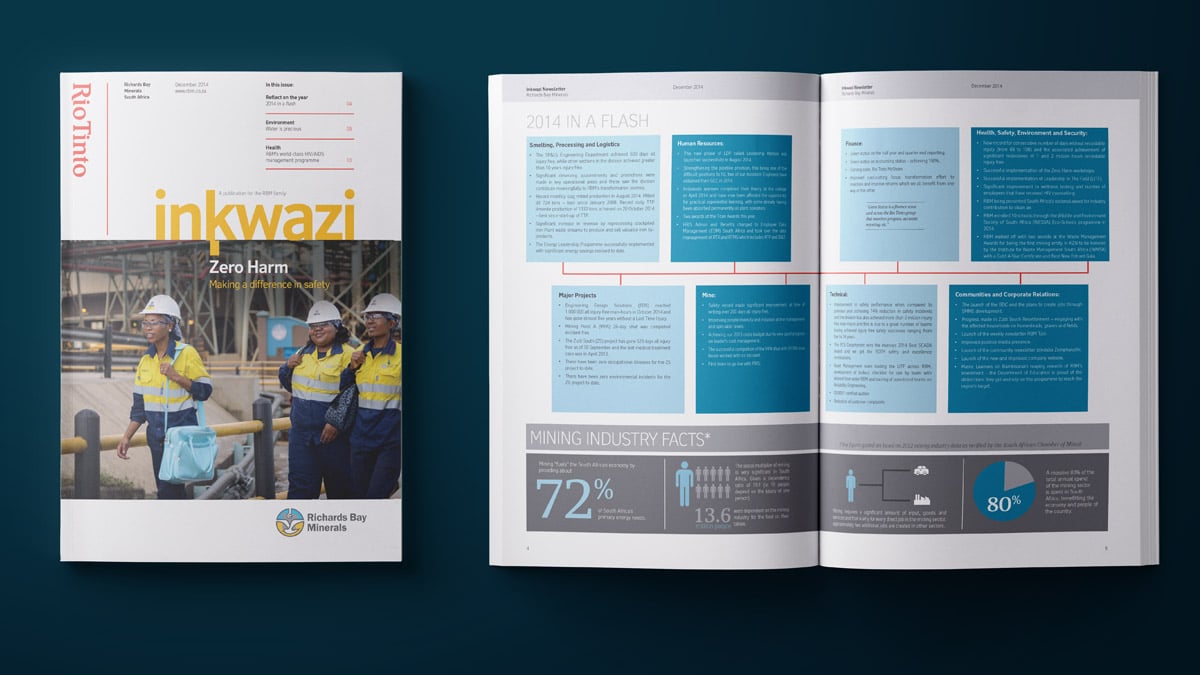
- Printed and digital employee newsletters
- Notice boards and internal displays
- Employee engagement and anniversary campaigns
- Internal events and leadership communication
- Community-facing communication aligned to the refreshed brand
Brand audits continued at key stages to ensure consistency held as the organisation evolved.
Best company, hands down
It’s very rare to find a company whose team is highly professional, friendly and creative. Their consistency and work ethic is second to none.
I can confidently recommend them as a highly efficient, innovative team of experts who will never fail to meet your expectations. Working with them is an absolute pleasure!”
Senior Communications Lead, Richards Bay Minerals

Scope and tactics delivered
Over the course of the relationship, through a coordinated system (now formalised as CommsKit), the transition was managed across a wide range of interconnected communication and brand activities. These are now delivered as part of a coordinated system, not isolated projects.
Change and transition
- Supported communications through the ownership change
- Explained the new governance to employees
- Briefed leaders through integration
Internal communications systems
- Built a regular rhythm of information reaching every site
- Ran engagement campaigns and newsletters, printed and digital
- Set up notice boards and on-site displays
Brand and identity
- Moved RBM from its own branding onto Rio Tinto standards
- Wrote and managed brand guidelines, adapted for site use
- Audited sites in South Africa, Guinea and Madagascar, correcting drift as it appeared
- Gave internal teams a way to hold multiple suppliers to one standard
Physical environments
- Re-signed site and wayfinding signage
- Designed safety-critical and compliance communications for site use
High-impact assets
- Shot photography on sites in South Africa, Madagascar and Guinea, used across the group globally
- Designed sustainability and corporate reporting
- Ran campaigns beyond the routine calendar
Impact and value created
The result was a visible shift in how communication was experienced across the organisation:
Employees got clearer communication, and internal teams got a system they could keep running.
A single, coherent system
One "source of truth" for brand and comms across multiple global sites.
Increased trust
Clearer alignment between local operations and global standards reduced anxiety during the transition.
Operational efficiency
Reduced reliance on ad-hoc communication, duplicated efforts, and expensive rework.

How this work maps to CommsKit today
This long-term engagement reflects the principles now built into CommsKit's modular system.
Relevant CommsKit solutions include:
- CommsKit ENGAGE – systemising ongoing mining internal communications across complex, operational workforces
- BrandKit – adapting and governing brand systems so they work in real operational environments
- CommsKit BOOST – supporting bespoke, high‑impact assets such as global photography and sustainability reporting
Today, CommsKit packages this approach into a managed, repeatable service that organisations can rely on through periods of change.
Managing a similar transition in your organisation? See how CommsKit can systemise your internal communications.